Population Monitoring

Community Reception Center Specifications

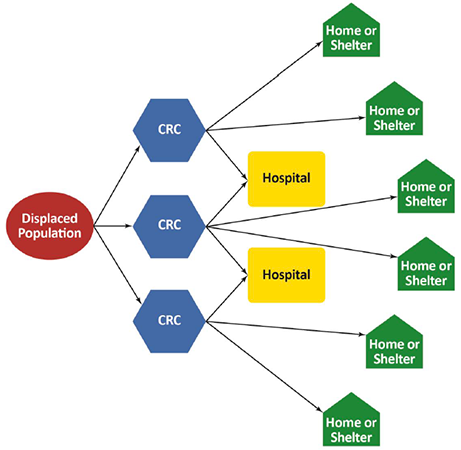
A radiation incident impacting a large population will require local response authorities to establish one or more population monitoring and decontamination facilities to assess people for exposure, contamination, and the need for decontamination or other medical follow-up. These facilities are known as community reception centers (CRCs).
CRCs should be located outside of the affected area and be operational within 24 to 48 hours after an incident or sooner if resources are available.
The basic services offered at a CRC include the following:

  • Screening people for radioactive contamination
  • Assisting people with washing or decontamination
  • Registering people for subsequent follow-up
  • Prioritizing people for further care
Figure 1: CRC Network Diagram


Initial Sorting Station

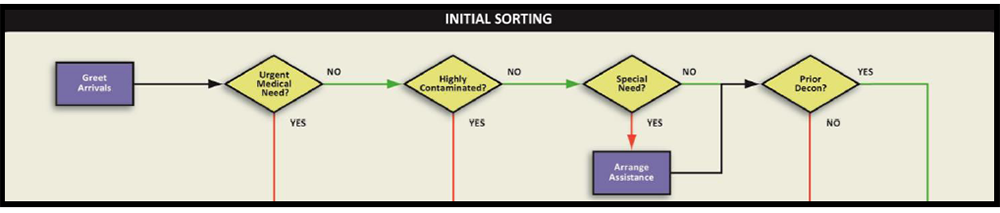
At the Initial Sorting Station, staff greet and direct people where to go in the CRC. Staff will determine whether a person

  • has an urgent medical need.
  • is highly contaminated with radioactive material.
  • requires special assistance.
  • has already showered or been decontamindated before coming to the CRC.

Initial Sorting staff may also assign ID numbers to people as they enter. These ID numbers can be used for record-keeping purposes and tracking people and their belongings through the center.

Contamination Screening staff may be assigned to the Initial Sorting Station to screen people and pets for high levels of radioactive contamination. This screening should be quick and nonintrusive, and it can be done with a variety of radiation detection instruments. Planners should consult the radiation control authorities in their jurisdictions to develop the screening protocol for the Initial Sorting Station.

People who have special needs should be accompanied through the CRC by a staff member or a caregiver. Children should not be separated from their parents. Some processes may need to be modified to accommodate children or people with special needs. People arriving with pets should be directed to the Pet Services Station to evaluate their pets for contamination.


initial-sorting


First Aid

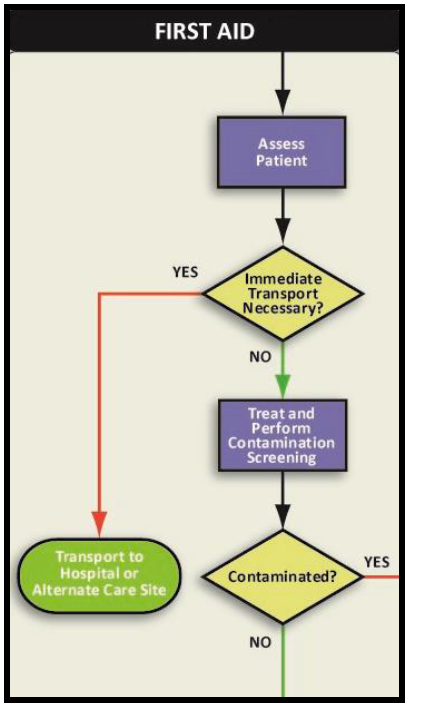
A person with an urgent medical need should be taken directly to the First Aid Station to receive medical care. First Aid staff and Contamination Screening staff should work together to assess the patient’s medical needs and, if the patient has not yet been through the Contamination Screening Station, quickly screen the patient for contamination.
If the patient needs advanced medical care, First Aid staff should request medical transport through the chain of command or by calling 911. If the patient is contaminated with radioactive material, First Aid staff can perform a gross decontamination by carefully removing the patient’s outer layer of clothing before transport. Lifesaving care should not be delayed due to concerns of cross-contamination.


Contamination Screening Station

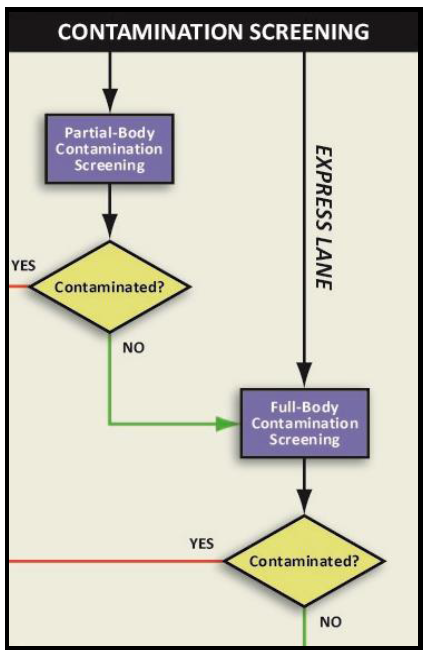
The Contamination Screening Station is where people are monitored for radioactive contamination. Depending on the resources and staff available, a combination of partial-body and full-body contamination screenings can be used to identify contaminated people. An express lane can be established for people who have showered or been decontaminated before coming to the CRC.
A partial-body contamination screening focuses on the hands, face, shoulders, head, and feet and can identify most contaminated people. If contamination is detected during this screening, that person will be escorted to the Wash Station. If not, that person will undergo a full-body contamination screening. The partial-body screening is an optional contamination control measure that protects other people waiting in line and the staff from cross-contamination.

The full-body screening should be conducted by trained staff using either handheld radiation detection instruments or portal monitors. If contamination is detected during this screening, that person will be escorted to the Wash Station. If not, that person will proceed to Registration. Planners should consult the radiation control authorities in their jurisdictions to determine screening protocols and release criteria for the Contamination Screening Station. Under certain circumstances, release criteria may need to be modified to alleviate bottlenecks at this station or at the Wash Station. For example, the Conference of Radiation Control Program Directors, Inc., has suggested release criteria for contamination screenings following a RDD ranging from 1,000 counts per minute (cpm) to 10,000 cpm, depending on the availability of decontamination resources.38

Appendix D provides a more detailed discussion of external contamination screening criteria.


Wash

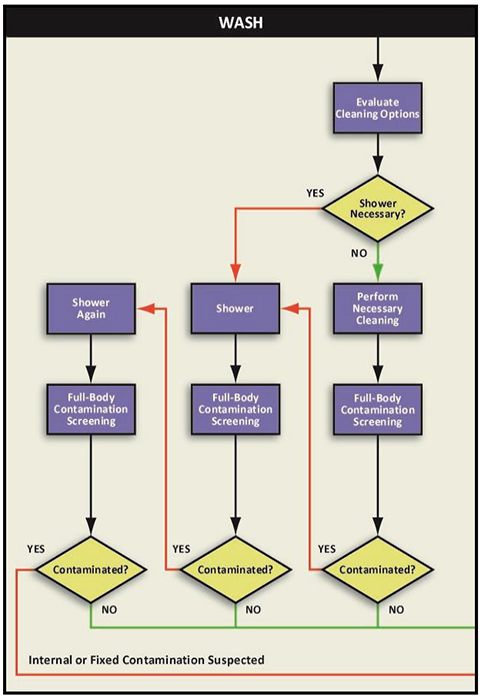
Wash Station staff review contamination screening results to determine the best method of decontamination for each contaminated person. After a person finishes washing, Contamination Screening staff will perform a full-body screening to ensure the person is clean and can proceed to Registration.

Depending on the resources available, CRC managers may decide to use existing indoor shower facilities or an outdoor decontamination unit. Contaminated clothing should be bagged and labeled with the person’s name and ID number assigned upon entering the CRC.

Contaminated clothing may be required later for epidemiological or law enforcement purposes. Bagged clothes should be stored in a secure, remote location at the CRC.

Other personal belongings, such as wallets, keys, jewelry, and glasses, should not be taken permanently from the owners. As people go through the Wash Station, their personal items should be bagged, labeled with the owner’s information, and returned to the owner when he or she exits the Wash Station. If resources permit, these items can be screened for contamination and, if possible, decontaminated before being returned.

Because Wash Station staff will be assisting contaminated people, they will need personal protective equipment to control cross-contamination. This equipment should provide splash protection when working near showers or decontamination units. The site safety officer should coordinate with radiation protection professionals to conduct a hazard assessment and issue the appropriate personal protective equipment to staff members at this station.


Pet Services

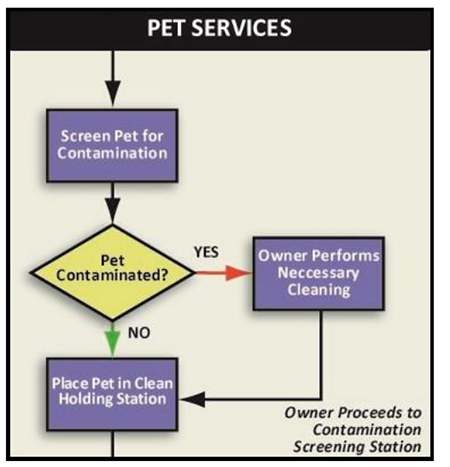
People arriving to the CRC with pets or service animals will be evaluated for urgent medical conditions and screened for high levels of radioactive contamination before being directed to the Pet Services Station. Contamination Screening staff will provide a quick screening of pets and service animals. If they are contaminated, the owners will be asked to wash the animal. If the owners are not physically capable, trained staff should be available to provide assistance. After cleaning, pets will be held in an on-site kennel until the owner is discharged from the CRC. Service animals will be allowed to enter the CRC with their owners.

Planners should work closely with partner agencies, such as the Humane Society of the United States, to ensure adequate accommodations for pets.


Registration Services

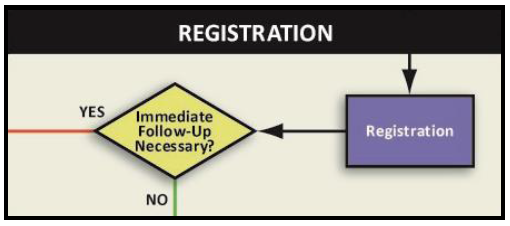
Registration staff personnel collect demographic and incident-specific information from people who have been screened for radioactive contamination and cleared to enter the Clean Zone.

registration
This information is used to determine whether someone needs immediate follow-up at the Radiation Dose Assessment Station and possibly long-term follow-up.

Information collected at the CRC must be accurate and accessible for possible additional interviews and investigations. Procedures for managing data need to be clear and easy to understand. Planners should consider modifying existing tools to capture information unique to radiological or nuclear incidents. Because people reporting to this station have been screened and cleared, staff here and at other stations in the Clean Zone require only minimal, if any, personal protective equipment.


Radiation Dose Assessment Station

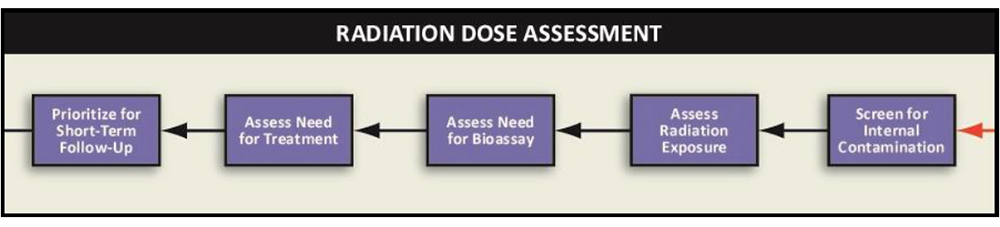
The Radiation Dose Assessment Station requires specialized staff and equipment to

  • screen people for potential internal contamination.
  • assess each person’s radiation dose.
  • collect blood or urine samples for laboratory analysis.
  • assess each person’s need for treatment.
  • prioritize people for further care.

Planning to provide these services should be flexible and scalable, incorporating additional resources as they become available.
If possible, CRC managers should assign a physician and a health physicist to oversee the Radiation Dose Assessment Station. Clinicians and radiation protection professionals will need to work together to determine the person’s radiation dose and need for additional medical care or follow-up.
Screening people for internal contamination at the CRC may not be possible in all situations; however, the information gathered from this process can help clinicians prioritize patients for additional medical care or follow-up. If resources are available at the CRC, blood samples can be collected for radiation dose assessment or urine samples can be collected to assess the degree of internal contamination. Trained laboratory staff should oversee sample collection and shipment to appropriate laboratories for processing. As with any medical consultation, staff at this station should take reasonable care to protect a patient’s confidentiality and medical information.


initial-sorting


Radiation Dose Assessment Station Discharge Station

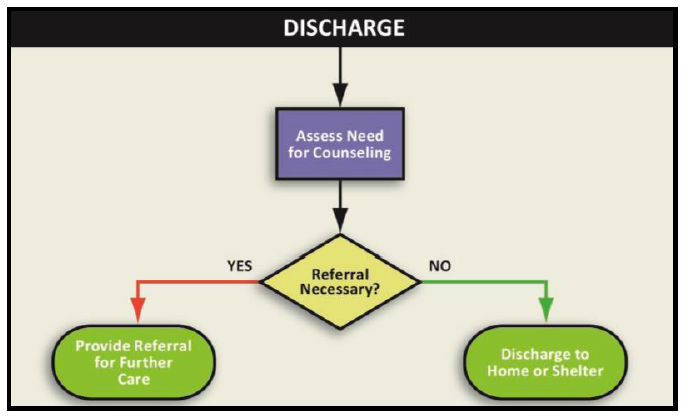
Discharge staff provide information for people leaving the CRC, including referrals to hospitals or alternate care sites for additional medical follow-up. As possible, mental health professionals at this station will assess each person’s need for counseling and make themselves available to address psychological needs elsewhere in the CRC. People leaving the CRC may be

  • referred for additional care.
  • discharged to their home, to the home of a friend or family member, or to a public shelter.

Planners should work closely with partner agencies, such as the American Red Cross, to streamline the transition from the CRC to a public shelter and to ensure adequate relocation services are provided.


initial-sorting