Although most of the population monitoring focus is devoted to the level of the contamination on people as determined by the decision levels noted on the next few pages, the biggest influence on the level of contamination detected is mostly dependent on the instrument and method used for primary detection.
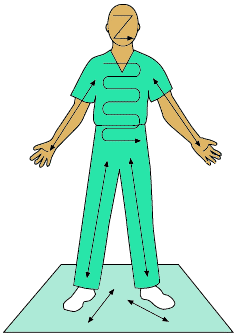
For example: if the detection objective is 0.1 uCi (2.2x10⁵ dpm) of a beta/gamma emitter, and the survey equipment being used is a CDV-718 with end window detector, then a painstakingly slow 16 minutes per person survey would be required. Since most field surveys cannot take this amount of time, it is likely that a person would be surveyed and released even if they are contaminated above the decision criteria.
|
Instrument/ Detector Combination |
Effort
to find 0.1 µCi (Monitoring
Criteria) |
Effort to find 1.0 µCi (Screening Criteria) |
||||||
|
Probe Speed (inches/s) |
Height
of Probe (inches) |
Path Width (inches) |
Time Needed to Monitor an Adult (minutes) |
Probe Speed (inches/s) |
Height
of Probe (inches) |
Path Width (Inches) |
Time Needed to Monitor an Adult (minutes) |
|
|
CD V-700
with side window detector |
4 |
0.25 to 0.5 |
0.6c |
19 |
6 |
1 to 2 |
2 |
3.9 |
|
CD V-718
with end window detector |
3 |
0.5 to 1 |
1 |
16 |
6 |
1 to 4 |
3 |
2.6 |
|
All tested
instruments with pancake detector
except the Victoreen 190 |
6 |
1 to 3 |
2 |
3.9 |
24 |
2 to 6 |
7 |
0.28 |
|
Victoreen
190 with pancake detector |
6 |
1 to 4 |
3 |
2.6 |
24 |
2 to 6 |
8 |
0.24 |
Table taken from analysis and testing performed by FEMA documented in BACKGROUND INFORMATION ON FEMA-REP-22: CONTAMINATION MONITORING GUIDANCE FOR PORTABLE INSTRUMENTS USED FOR RADIOLOGICAL EMERGENCY RESPONSE TO NUCLEAR POWER PLANT ACCIDENTS.
The concept of limit of detection for fixed vs moving monitoring is poorly understood. For example, despite the fact that hovering over 0.1 uCi (2.2x10⁵ dpm) with a modern pancake probe would likely result in a count rate over 10,000 cpm, scanning the same detector more than 6 inches per sec over the same source would likely result in no observable change in background count rate. This also demonstrates why “twice background” is not a realistic decision level without hours of survey per person, however it is an integral part of the contamination detection method as it is essentially how the operator knows where to stop and make a decision level measurement.
In other words, how we conduct the contamination survey can be much more important than decision levels once contamination is found. Although FEMA REP-22 is primarily for nuclear power plant accidents, the methods and recommendations it provides are appropriate for other incidents involving beta/gamma emitters.
|
Contamination
Detection Method for nuclear detonation fallout, if potentially
contaminated with fallout from a nuclear detonation, early gross
decontamination is more important than radiation screening. If trying to identify significantly
contaminated individuals in a resource constrained environment,
use the IAEA
method of 10 mR/hr (100 µSv/h) at 1 m. Detection Method in a resource constrained event or when wait times exceed 1 hour, use the instrument specific monitoring parameters for 1.0 uCi provided by FEMA REP-22. This will result in screening speeds of ~ 30 seconds per person for a modern pancake GM instrument (see orange column above). Consider concentrating surveys on parts of the body most likely to be contaminated. Detection Methods
for all other beta/gamma activities, use the instrument specific
monitoring parameters for 0.1 uCi provided by FEMA REP-22. This result in screening speeds of ~ 4
minutes per person for a modern pancake GM instrument (see blue column above). |