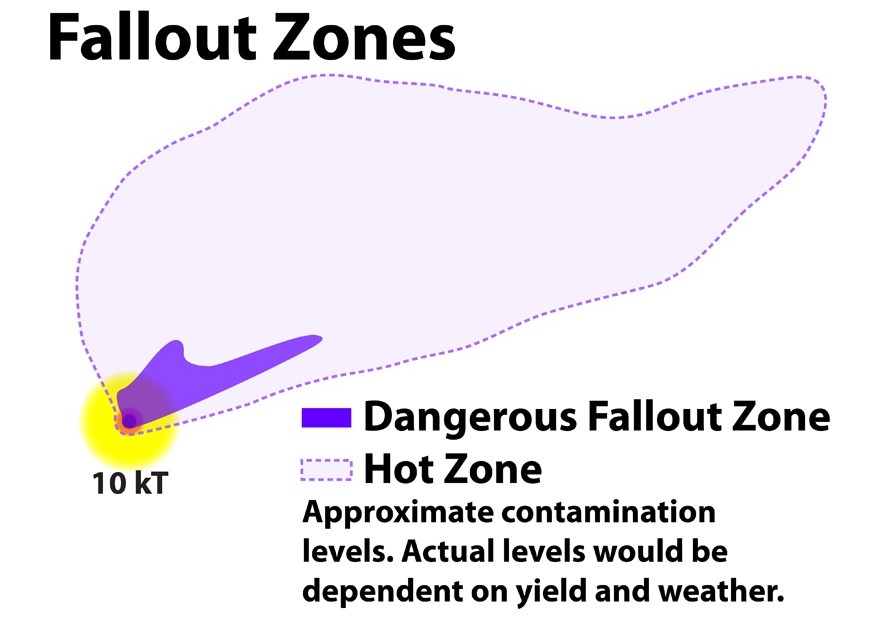
 Within the Hot Zone, many guidance documents define higher level
radiation exposure rates in which additional controls or actions would be
required. For incident specific Recommendations, contact the Advisory Team for
Environment, Food and Health (A-Team) via FDA EOC: 866-300-4374.
Within the Hot Zone, many guidance documents define higher level
radiation exposure rates in which additional controls or actions would be
required. For incident specific Recommendations, contact the Advisory Team for
Environment, Food and Health (A-Team) via FDA EOC: 866-300-4374.
The implication of these exposure rate / dose rate values and their intended purpose vary, here are examples of the most common uses:
· Higher Hazard Zone: used to define an area (or zone) that should be avoided or additional control applied
· Decision Point: an exposure rate where a verification of the benefit of the responder’s actions justify the risk
· Turnback levels: an individual responder’s indication that they should not continue forward
Even with these high dose rate hazard definitions, most guidance documents provide the caveat that the responder can continue under certain circumstances. The ROSS should clearly identify when responders should consider entering a high hazard zone or continuing past a turnback level and be provided with methods to minimize exposure (e.g., require active dose monitoring and limit time spent in area).
Zones should only be defined when substantially different actions or protective measures are required. The use of more than 2 zones (e.g., Hot and Dangerous) should be avoided as it adds unnecessary complexity to incident mapping / tracking activities.
Defining a High Hazard Zone (based on radiation measurements)Dangerous Radiation Zone The NCRP Report 165 is clear in its terminology and use of the word “dangerous.” This is also the same value, but a broader application, as the (similar sounding) Dangerous Fallout Zone in the Federal Planning Guidance for Response to a Nuclear Detonation. This zone is defined by:
It should be noted that responders can likely work in these areas for several hours without adverse acute effects, however doses are high enough that the area should be avoided unless there is a compelling immediate need. Responders should not perform surveys near or try put barriers around this zone as that would represent an unjustified exposure for the responder assigned the task. Turnback level When an individual responder encounters dose rates
exceeding 200 R h–1, the possibility of
acute effects to the responder and the likelihood of viable survivors after the
first few hours is very low. Only volunteers who are aware of the risks and
have a clear, mission critical activity to perform should proceed. |
|
Numerical Value |
Terminology Used |
Reference Document |
|
1,000 R/h |
Do Not Enter |
(NCRP, 2008) |
|
200 R/h |
Turnback Level |
(CRCPD, 2006) |
|
100 R/h |
High Exposure Rate |
(ASTM, 2015) |
|
Do Not Procced |
(IAEA, 2006) |
|
|
Turnback limit |
(NCRP, 2008) |
|
|
10 R/h |
Dangerous Radiation Zone |
(NCRP, 2010) |
|
Dangerous Radiation Zone |
(DHS, 2017) |
|
|
Dangerous Fallout Zone |
(DHS, 2016) |
|
|
Dangerous Fallout Zone |
(EOP, 2010) |
|
|
Extreme Caution Zone |
(CRCPD, 2006) |
|
|
Inner Perimeter |
(NCRP, 2005) |
|
|
Turnback limit |
(NCRP, 2008) |
|
|
Inner Contaminated Area |
(NCRP, 2008) |
|
|
1 R/h |
High Radiation Zone |
(CRCPR, 2006) |
|
0.1 R/h |
Medium Radiation Zone |
(CRCPR, 2006) |
|
HIGH HAZARD ZONES based on radiation measurements |
||||||
|
Reference |
Applies To |
Zone Name |
Demarcation Name |
Numerical Value (see Unit conversion notes) |
Actions |
Discussion |
|
ASTM E2601-15: Standard Practice for Radiological Emergency Response (ASTM, 2015) |
Emergency situations |
None |
High exposure rate
|
100 R/h
“High exposure rate: not to exceed 100 R/h (1 Sv/h) when reasonably achievable.”
|
high exposure rate—exposure rate beyond which emergency response is not recommended for rescue operations unless the incident commander (IC) determines it can be carefully controlled for a short duration for priority operations such as life-saving, and the emergency responder is informed of the hazards and consents to performing the operation(s); the recommendation of this standard practice is for a high exposure rate less than or equal to 100 R/h (1 Sv/h). For the purposes of this standard practice, the term “high dose rate” is equivalent to “high exposure rate.” |
Pros: This value could be reasonable “turn-back” alternative to the CRCPD 200 R/h.
Cons: This might be too restrictive. At 100 R/h, a responder could perform 15 minutes of life saving activities before reaching the EPA guideline of 25 Rem. |
|
IAEA Manual for First Responders to a Radiological Emergency (IAEA, 2006) |
Emergency situations, |
None |
None. |
10 rem/h
“100 mSv/h (10 rem/h)”
|
If ambient dose rate in a particular area is greater than 100 mSv/h (10 rem/h): (a) Perform only life saving actions. (b) Limit total time of staying there to 30 minutes. |
Same as NCRP 165’s Dangerous Radiation Zone. Adds a 30 minute stay time.
Pros: IAEA reinforces that for dose rates above 10 R/h, life saving activities are still appropriate, but responders should proceed with caution.
Cons: 30 minutes at 10 rem/h would result in 5 rem, higher doses can be considered for life saving. |
|
IAEA Manual for First Responders to a Radiological Emergency, (IAEA, 2006) |
Emergency situations, |
Do Not Proceed |
None. |
100 rem/h
“1000 mSv/h (100 rem/h)” |
Do not proceed into area with an ambient dose rate of greater than 1000 mSv/h (100 rem/h) unless directed by radiological assessor. |
This Do Not Proceed point is similar to ASTM’s High Exposure Rate and language similar to “turn-back” concepts.
Pros: This value could be reasonable “turn-back” alternative to the CRCPD 200 R/h.
Cons: This might be too restrictive. At 100 R/h, a responder could perform 15 minutes of life saving activities before reaching the EPA guideline of 25 Rem. |
|
CRCPD RDD Handbook (CRCPD, 2006)
|
RDD Events |
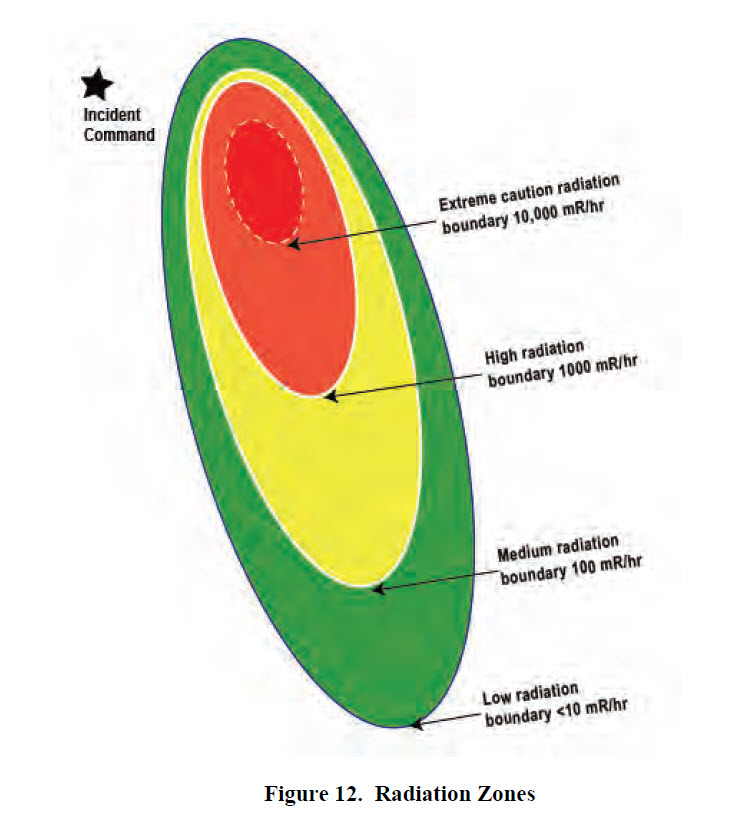
Medium Radiation Zone |
N/A |
0.1 R/h
“100 - 1000 mR/hr”
|
Medium Radiation Zone: Restrict access to only authorized personnel. Personal dosimetry should be worn. Serves as a buffer zone/transition area between the high and low radiation zones. People within this zone at the time of the explosion should be surveyed for contamination before being released. (For RDDs up to ~ 10,000 Ci, this may be the highest radiation zone that exists.)
|
Pros: CRCPD’s RDD Handbook is a practical guide for RDD response, created for a non-technical end-user with some practical rules of thumb and example forms and worksheets. The CRCPD guidance provides 4 different zones (and a turnback level), providing the ROSS greater flexibility to justify a Zone decision.
Cons: It is only for RDDs and the 4 zones have non-descriptive names (low, medium, high, extreme caution radiation zones). The different zones do not have appreciably different activities or protective measures defined. Contamination action levels are provided in CPM which is instrument dependent so actual contamination levels are unclear. |
|
CRCPD RDD Handbook (CRCPD, 2006)
|
RDD Events |
High Radiation Zone
|
N/A |
1 R/h
“1000 - <10,000 mR/hr” |
High Radiation Zone: Restrict access to authorized personnel with specific critical tasks such as firefighting, medical assistance, rescue, extrication, and other time- sensitive activities. Personal dosimetry should be worn. People within this zone at the time of the explosion should be surveyed for contamination before being released. |
Pros: It is a practical guide for RDD response, created for a non-technical end-user with some practical rules of thumb and example forms and worksheets. The CRCPD guidance provides 4 different zones (and a turnback level), providing the ROSS greater flexibility to justify a Zone decision.
Cons: It is only for RDDs and the 4 zones have non-descriptive names (low, medium, high, extreme caution radiation zones). The different zones do not have appreciably different activities or protective measures defined. Contamination action levels are provided in CPM which is instrument dependent so actual contamination levels are unclear. |
|
CRCPD RDD Handbook (CRCPD, 2006)
|
RDD Events |
Extreme Caution Zone
|
N/A |
10 R/h
“≥ 10,000 mR/hr (turn-back exposure rate)”
|
Extreme Caution Zone: This area, located within the high radiation zone, is restricted to the most critical activities, such as lifesaving. Personal dosimetry required, although one monitor for several responders is acceptable if they remain near the person with the monitor. Limit time spent in this area to avoid Acute Radiation Sickness. People within this zone at the time of the explosion must be surveyed for contamination before being released. |
The CRCPD “highest level” zone is the same as NCRP 165’s Dangerous Radiation Zone.
Oddly, it also refers to this value as a possible turnback level, but then offers a separate (20X higher) turnback level.
Pros: The “Extreme Caution” zone is consistent with the Dangerous Radiation Zone.
Cons: too many zones. See other zones for additional Pros / Cons. |
|
RDD Events |
Turn-Back Level
|
N/A |
200 R/h
Suggested Turn-Back Exposure Rates: “200,000 mR/hr 2 Extreme Caution” |
Suggested Turn-Back Exposure Rates: 200,000 mR/hr 2 Extreme Caution
|
Note: This Turnback level was identified as the recommended ROSS default value.
Pros: this dose rate is sufficiently high enough to warrant stopping responders to prevent potential acute effect if the radiation fields continue to rise or timeframes exceed 30 minutes.
Cons: If strictly adhered to, terms like “turn back” and “do not proceed” values imply that responders should never proceed. However, very short (a few minutes) life saving activities should still be considered. |
|
|
Emergency situation, terrorism focused |
N/A |
Inner Perimeter |
10 R/h
“Establish an inner perimeter at 10 R/h exposure rate (~0.1 Gy/h air-kerma rate).” |
…actions taken within this area should be restricted to time-sensitive, mission-critical activities such as life-saving |
Same as NCRP 165’s Dangerous Radiation Zone. Commentary 19 used inner and outer perimeter before being superseded by “Hot Zone” and Dangerous Radiation Zone” in Report 165.
Pros: NCRP C19 reinforces that for dose rates above 10 R/h, lifesaving activities are still appropriate, but responders should proceed with caution and use additional controls. |
|
|
Management of Terrorist Events Involving Radioactive Material (NCRP, 2001) |
Emergency situation, terrorism focused |
N/A |
None, however this is the recommended “second alarm level” |
10 rem/h
“approximately 10 rem/h or 10 Rem (0.1 Sv/h or 0.1 Sv).” |
The second alarm level, the “turn-around” level, is necessary to permit this initial emergency response team to perform additional time-sensitive, critical missions beyond the point where it is recognized that there is a radiological component to the disaster. The NCRP recommends an ambient dose rate and ambient dose for this purpose would be approximately 10 rem/h or 10 Rem (0.1 Sv/h or 0.1 Sv). It is essential, however, that initial responders not proceed beyond the point at which the initial alarm level has been reached unless there is a compelling reason to do so. Such reasons include the rescue of injured persons and time-sensitive actions to regain control of the scene. However, if the first responders include personnel with radiation health expertise and more sophisticated equipment, it is more appropriate that judgments involving higher exposures be made at the scene taking into account all the relevant factors specific to the conditions at the scene. |
Same as NCRP 165’s Dangerous Radiation Zone. Although the alarm is designated as the “turn around” alarm, the text makes it clear that this value is for the dangerous radiation zone, which can be entered for “time-sensitive, critical missions” where additional controls are taken to ensure responder safety.
Pros: NCRP 138 reinforces that for dose rates above 10 R/h, lifesaving activities are still appropriate, but responders should proceed with caution.
Cons: the use of the term “turn-around” may be confusing even though it states a lifesaving exception. |
|
NCRP Report No. 161: Management of Persons Contaminated With Radionuclides: Handbook (section 3.4) (NCRP, 2008) |
Radiological or nuclear incident or emergency |
N/A |
N/A |
10 rad/hr
“>0.1 Gy/h (10 rad/h)” |
Do not attempt to enter areas in which radiation levels are >0.1 Gy/h (10 rad/h) without radiation dosimeters and radiation detector OR an accompanying radiation-safety specialist, AND the concurrence of the incident commander or a designated health and safety supervisor. Radiation levels should be determined by survey with an ion chamber, micro-R meter, or energy-compensated GM detector. |
Same as NCRP 165’s Dangerous Radiation Zone.
Pros: NCRP 161 reinforces that for dose rates above 10 R/h, lifesaving activities are still appropriate, but responders should proceed with caution with additional controls.
|
|
NCRP Report No. 161: Management of Persons Contaminated With Radionuclides: Handbook (Emergency guidance in Table 3.1) (NCRP, 2008) |
Incident Site |
Turn-back limit |
N/A |
10 R/h
“100 mGy/h (10 R/h)” |
Action: Turn-back limit except for grave emergency for lifesaving.
Significance: Radiation workers will exceed annual dose limit [50 mSv (5 rem)] in 30 min. (excerpt from table 3.1) |
NCRP 161’s Chapter 3 is a “Compendium of Radiation Facts and Guidance” in which internally inconsistent recommendations are provided. This results in the appearance of endorsement and this report can be essentially quoted to provide support for just about any value. Pros: this reference provides justification for a number of dose rates that the ROSS may consider the use of, NCRP 161 reinforces that for dose rates above 10 R/h, lifesaving activities are still appropriate, but responders should proceed with caution with additional controls.
Cons: the use of the term “turnback” may be confusing even though it states a lifesaving exception. Table 3.1 is an excellent example in that it provides recommended turnback levels of 10, 100, and 1000 R/h all in the same table for essentially the same conditions. |
|
NCRP Report No. 161: Management of Persons Contaminated With Radionuclides: Handbook (Emergency guidance in Table 3.1) (NCRP, 2008) |
Incident Site |
Turn-back limit |
N/A |
100 R/h
“1 Gy/h (100 R/h)”
|
Action: Turn-back limit except for lifesaving, minimize time in these areas.
Significance: May develop radiation sickness with 1 h exposure. (excerpt from table 3.1) |
NCRP 161’s Chapter 3 is a “Compendium of Radiation Facts and Guidance” in which internally inconsistent recommendations are provided. This results in the appearance of endorsement and this report can be essentially quoted to provide support for just about any value.
Pros: this reference provides justification for a number of dose rates that the ROSS may consider the use of,
Cons: the use of the term “turnback” may be confusing even though it states a lifesaving exception. Table 3.1 is an excellent example in that it provides recommended turnback levels of 10, 100, and 1000 R/h all in the same table for essentially the same conditions. |
|
NCRP Report No. 161: Management of Persons Contaminated with Radionuclides: Handbook (Emergency guidance in Table 3.1) (NCRP, 2008) |
Incident Site |
Do not enter |
N/A |
1,000 R/h
“10 Gy/h (1,000 R/h)” |
Action: Do not enter except under the most severe circumstances Significance: • May develop radiation sickness with 5 – 6 min exposure • Will reach LD50 dose (the lethal dose to 50 % of the population) in 30 min • Will receive lethal dose in 1 h (excerpt from table 3.1) |
NCRP 161’s Chapter 3 is a “Compendium of Radiation Facts and Guidance” in which internally inconsistent recommendations are provided. This results in the appearance of endorsement and this report can be essentially quoted to provide support for just about any value. It is worth noting that the calculations in the table 3.1’s “Significance:” column are mathematically a little off (and confusing) for this particular turnback recommendation.
Pros: this reference provides justification for a number of dose rates that the ROSS may consider the use of,
Cons: the use of the term “turnback” may be confusing even though it states a lifesaving exception. Table 3.1 is an excellent example in that it provides recommended turnback levels of 10, 100, and 1000 R/h all in the same table for essentially the same conditions. |
|
NCRP Report No. 161: Management of Persons Contaminated With Radionuclides: Handbook (section 18.3) (NCRP, 2008) |
RDD Events |
inner contaminated area |
Inner perimeter |
10 R/h
“NCRP recommends establishing an inner perimeter at ~0.1 Gy h–1 (10 R h–1) air-kerma rate which would correspond to the perimeter of the inner contaminated area “ |
Public: Within the inner contaminated area, the appropriate actions are to evacuate or temporarily relocate the people, isolate the area, and ensure that all emergency workers inside the area follow appropriate personal protection guidelines Responder: The inner contaminated area is defined as the site of the release of radionuclides and, therefore, contains the highest levels of contamination, the highest radiation levels, and likely the most serious nonradiological risks to life and health. All persons in this area should be assumed to be contaminated and be required to exit only through a proper control point, be surveyed and decontaminated if necessary. All personnel working in this area will be expected to follow appropriate radiological precautions, including wearing personal protective equipment (PPE), monitoring radiation dose and dose rates, practicing ALARA, and maintaining an awareness of other 10 R/h dangers to which they may be exposed. If the contamination incident is the result of a malicious act or a terrorist attack, all personnel in this area should try to avoid actions that might destroy the integrity of a possible crime scene, and should be aware of the possibility of non-radiological hazards such as fires, broken utility lines, unexploded ordnance, and damaged or unstable structures. Discipline specific guidance can be found in section 18.3.1 |
Warning: do not interpret “All persons in this area should be assumed to be contaminated and be required to exit only through a proper control point, be surveyed and decontaminated if necessary” to imply that people should be contained within the dangerous radiation zone. Any surveys and decon should be performed outside of the Hot Zone.
NCRP 161’s Chapter 3 is a “Compendium of Radiation Facts and Guidance” in which internally inconsistent recommendations are provided. This results in the appearance of endorsement and this report can be essentially quoted to provide support for just about any value.
Pros: this reference provides justification for a number of dose rates that the ROSS may consider for use. NCRP 161 reinforces that for dose rates above 10 R/h, lifesaving activities are still appropriate, but responders should proceed with caution with additional controls.
Cons: the use of the term “turnback” may be confusing even though it states a lifesaving exception. Table 3.1 is an excellent example in that it provides recommended turnback levels of 10, 100, and 1000 R/h all in the same table for essentially the same conditions. |
|
Emergency situation, terrorism focused |
Dangerous Radiation Zone |
Inner perimeter
|
10 R/h
“10 R/h (~0.1 Gy/h)”
|
EMERGENCY RESPONDERS: Emergency responders who enter the Hot Zone should be equipped with radiation monitoring equipment that provides unambiguous alarms, based on predefined levels, to facilitate decision making. It is recommended that the instrument alarm when the exposure rate reaches 10 R/h (~0.1 Gy/h), corresponding to the recommended value for the inner perimeter of the dangerous-radiation zone, and when the cumulative absorbed dose reaches the decision dose of 50 rad (0.5 Gy) (NCRP, 2005).
NCRP does not recommend a dose limit for emergency responders performing time-sensitive, mission critical activities such as lifesaving. Instead, decision points should be established by the incident commander based upon operational awareness and mission priorities.
PUBLIC: Recommendation: NCRP recommends that the initial public protective action for both radionuclide dispersion incidents and nuclear detonations be early, adequate sheltering followed by delayed, informed evacuation. Until the level and extent of contamination can be determined, efforts should be made to avoid being outdoors in potentially-contaminated areas |
NCRP 165 definition of a Dangerous Radiation Zone is used as the default recommended level and definition for a higher hazard zone within the Hot Zone where additional controls should be required. Available for free download.
Pro: NCRP 165 is the most recent NCRP document pertaining to zone definitions and should be a primary reference for the ROSS. The Dangerous Radiation Zone terminology is also consistent to the level and wording of federal guidance on fallout (called the Dangerous Fallout Zone). The document also provides the most detailed recommendations on the additional controls and requirements to work in this zone.
Cons: none |
|
|
IND Incidents |
Dangerous Fallout Zone |
10 R/h
|
10 R/h
exposure rate of .093 sievert/hour (10 roentgen/hour) or greater |
BRANCH 1: Improvised Nuclear Devices The Dangerous Fallout Zone is defined as a radiation exposure rate of .093 sievert/hour (10 roentgen/hour) or greater. Response operations within this zone must be avoided and if necessary, undertaken by extreme exception only. |
Reiterates the Federal Guidance for Response to Nuclear Detonation and is the same as NCRP 165’s Dangerous Radiation Zone.
Pros: consistent with NCRP and international guidance on a 10 R/h higher hazard zone. The fact that this is a DHS document associated with the National Response Framework provided ROSS with excellent justification to choose this value.
Cons: Uses SI units (with non-standard conversion assumptions). |
|
|
Federal Planning Guidance for Response to a Nuclear Detonation (EOP, 2010)
|
Nuclear Detonation |
Dangerous Fallout Zone |
|
10 R/h
|
Responder: “The most important mission in the DF zone is communicating protective action orders to the public. Effective preparedness requires public education, effective communication plans, messages, and means of delivery in the DF zone.”
The area covered by fallout that impacts responder life-saving operations and/or has acute radiation injury potential to the population is known as the dangerous fallout (DF) zone. |
The area covered by fallout that impacts responder life-saving operations and/or has acute radiation injury potential to the population is known as the dangerous fallout (DF) zone. Unlike the LD, MD, and SD zones, the DF zone is distinguished not by structural damage, but by radiation levels. A radiation exposure rate of 10 R/h is used to bound this zone, and the DF zone may span across both the LD and MD zones
Pro: For a nuclear detonation, this is the seminal guidance. It offers detailed guidance for all issues related to response to a nuclear detonation. It is available for free download and has a companion document on “Communicating in the Aftermath.”
Cons: Although some elements may pertain to other elements of a general radiation emergency, but was intended for many of the unique aspects and characteristics of a nuclear detonation. |