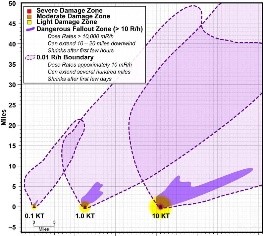
Most responder equipment can detect radiation and contamination at very low levels - levels that are far below a public or responder health and safety concern. Unfortunately, there is often a perception that all of the radioactive material (and radiation) is contained in the Hot Zone, and that the area beyond, sometimes called the Cold Zone is “clean” and free of radioactive material. Responders may be surprised and disconcerted when their instruments are providing readings (and often rapidly clicking) far above anything they encountered during training while still in the Cold Zone . The ROSS should be prepared to address concerns and justify the selection of Hot Zone values.
This may require a fundamental shift in thinking for responders and radiation safety professionals who usually try to control “any detectable” radiation to allowing some level of radiation and contamination as being acceptable outside the Hot Zone (even in staging, incident command posts, and rest areas). Exposures that would trigger emergency (early) phase protective action, such as shelter or evacuation, should still reside within the Hot Zone boundary. It is not practical, nor appropriate, to place boundaries at levels that do not represent a risk to the responder or the public when doing so would result in a significant detriment to response activities because of unnecessary delays due to travel times to and within the Hot Zone.
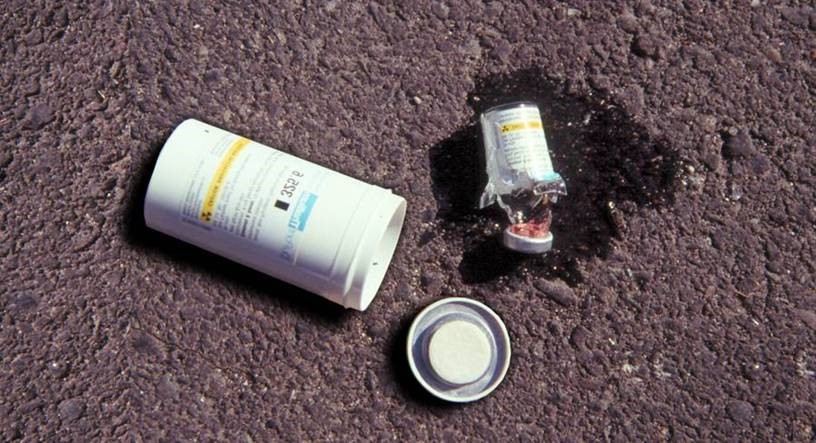
Figure 1 Small, isolated incidents can often be completely contained.
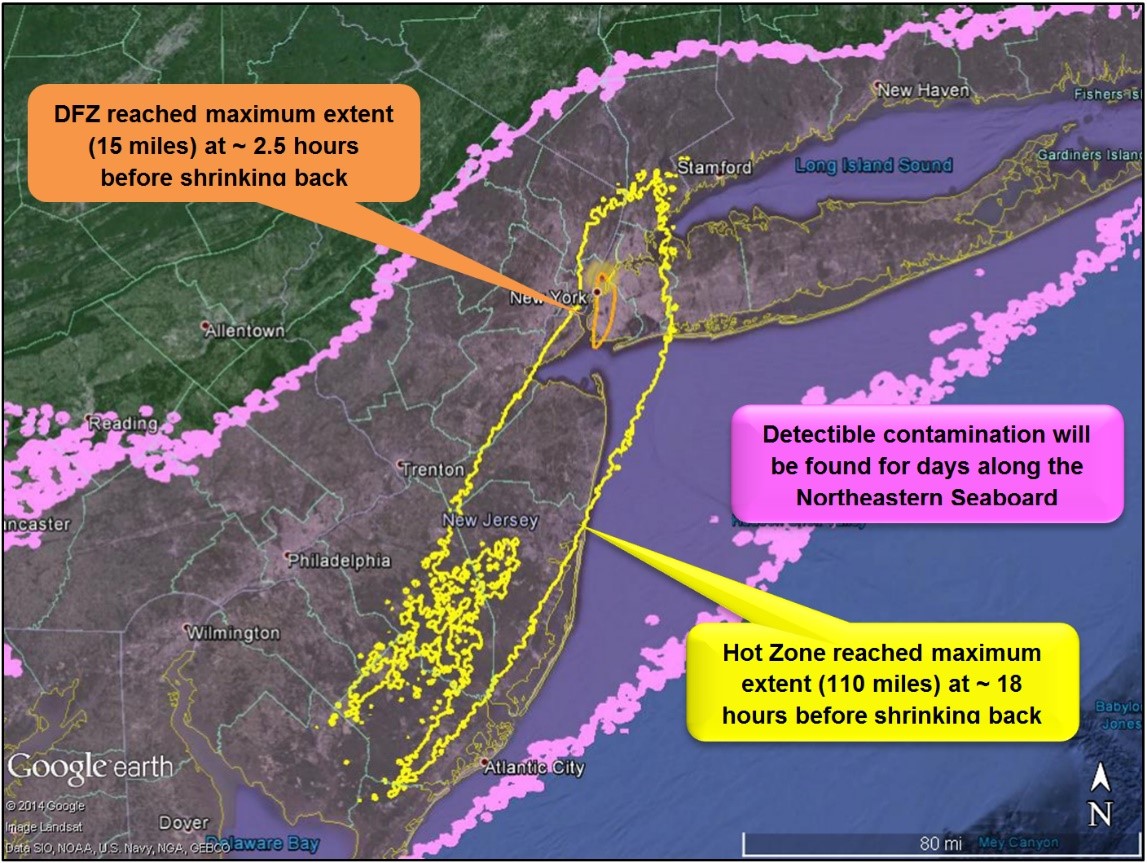
Figure 2 Detectable contamination (pink highlight) at 0.0001 R/hr, (which is 2-4 times background levels) in the region a week after a simulated 10kT nuclear yield in NYC. The yellow area represents the 10 mR/h hotline 18 hours after detonation.
Figure 2 Detectable contamination (pink highlight) at 0.0001 R/hr, (which is 2-4 times background levels) in the region a week after a simulated 10kT nuclear yield in NYC. The yellow area represents the 10 mR/h hotline 18 hours after detonation.
Summary of Numerical Values used for the Hot Zone
|
Numerical Value |
Terminology Used |
Reference Document |
|
10 mR/h |
Hot Zone |
(NCRP, 2010) |
|
Hot Zone |
(DHS, 2016) |
|
|
Hot Zone |
(DHS, 2017) |
|
|
0.01 R/hr Boundary |
(EOP, 2010) |
|
|
Outer Perimeter |
(NCRP, 2005) |
|
|
Inner Cordoned Area / Hot Zone |
(IAEA, 2006) |
|
|
Low Radiation Zone |
(CRCPD, 2006) |
|
|
≤ 10 mR/h |
Hot Zone |
(ASTM, 2008) |
|
5 mR/h |
DOE Regulatory Requirement for posting a radiation area |
(NCRP, 2008) |
|
2 mR/h |
NRC Regulatory Control Boundary |
(NCRP, 2008) |
|
2 mR/h |
Hot Zone |
Some training material, e.g. (FEMA 358, 2010) |
|
HOT ZONE based on radiation measurements |
|||||||
|
Applies to |
Zone Name |
Zone Demarcation |
Numerical Value |
Text from Reference |
Suggested Action |
Discussion |
|
|
ASTM E2601-15: Standard Practice for Radiological Emergency Response (ASTM, 2015) 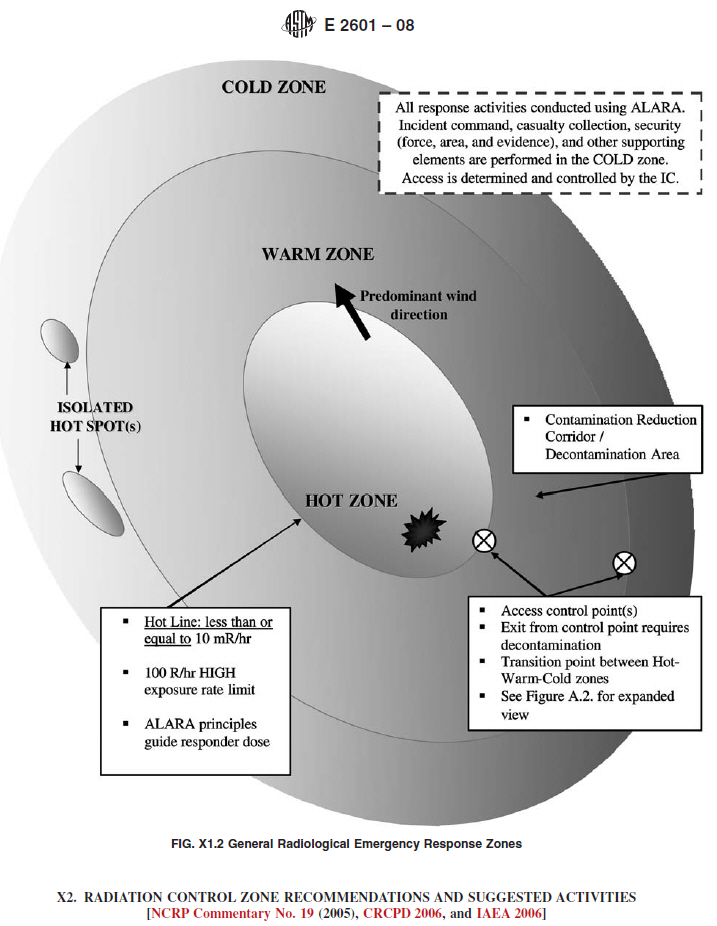
|
Emergency situations |
Hot Zone |
Hot Line
|
<= 10 mR/h |
Definition of radiological Hot Zone: if the radiological hazard controls determination of the hot line, the maximum exposure rate for the hot line is recommended to be less than or equal to 10 mR/h (0.1 mSv/h) at 1 m (3.3 ft); if radioactive material contamination is prevalent on scene, Annex A1 provides additional information regarding hot zone considerations |
Restrict access to essential individuals. Initial decontamination of emergency responders should occur near the outer boundary of this area. Uninjured personnel within this zone at the time of an RDD explosion can be directed to proceed directly home to shower if resources do not permit contamination surveying at the scene. For small RDDs this may be the only zone that exists.
offensive operation(s)—emergency response measures taken to reduce or minimize exposure from hazardous circumstances and materials to responders and civilians (for example, operations required within the Hot Zone); life-safety operations are top priority in offensive operations however evidence preservation shall be considered.
defensive operation(s)—emergency response measures taken from a safe distance (for example, outside the Hot Zone) to prevent or limit radiation exposure or the spread of hazardous material; life-safety operations are not a concern if defensive operations are the only operations supporting the response.
for a radiological response, the hot line shall correspond to a previously established exposure rate (for example, the low exposure rate) or contamination level above which personnel shall be trained and protected appropriately by personal protective equipment (PPE) to operate. The location of the hot line may not be determined based on radiation exposure rate or contamination level if a higher hazard associated with the incident presents greater risk. (NIMS 2007) |
The ASTM standard may have broader acceptance in the response community than NCRP or CRCPD. It did a good job of summarizing key references (as of 2008) and reaching a good, compromise approach. It is important to note that standard does not define a specific value, rather indicates that anything up to 10 mR/h is acceptable.
Pros: This standard can be helpful in supporting the use of a Hot Zone defined by radiation levels up to 10 mR/h. It also provides excellent “suggested actions” that are written for the responder community. It also identified the importance of being cognizant of non-radiological risks.
Cons: Its flexibility is also its vulnerability. Because it does not define a specific exposure rate for the hot line, people could challenge any decision based on this standard. |
|
Emergency situations, terrorism focus |
Hot Zone |
Outer Perimeter |
10 mR/h
60,000 dpm/cm2 (1,000 Bq/cm2) for beta and gamma surface contamination
6,000 dpm/cm2 (100 Bq/cm2) for alpha surface contamination |
Establish the Hot Zone boundary if any of the following exposure rate or surface contamination levels is exceeded: • 10 mR/h exposure rate (~0.1 mGy/h air-kerma rate); • 60,000 dpm/cm2 (1,000 Bq/cm2) for beta and gamma surface contamination; and • 6,000 dpm/cm2 (100 Bq/cm2) for alpha surface contamination. |
Emergency responders who enter the Hot Zone should be equipped with radiation monitoring equipment that provides unambiguous alarms, based on predefined levels, to facilitate decision making. It is recommended that the instrument alarm when the exposure rate reaches 10 R/h (~0.1 Gy/h), corresponding to the recommended value for the inner perimeter of the dangerous-radiation zone, and when the cumulative absorbed dose reaches the decision dose of 50 rad (0.5 Gy) (NCRP, 2005).
Outside of the dangerous-radiation zone, medical stabilization of the patient is the first priority. The stabilization of life-threatening injuries should never be delayed to address radionuclide contamination of the patient or exposure to the healthcare provider from such contamination.
PUBLIC Recommendation: NCRP recommends that the initial public protective action for both radionuclide dispersion incidents and nuclear detonations be early, adequate sheltering followed by delayed, informed evacuation. Until the level and extent of contamination can be determined, efforts should be made to avoid being outdoors in potentially-contaminated areas
Recommendation: The goal of response to a nuclear terrorism incident is to save lives while minimizing risks to emergency response workers. Unless there is an impact on life-safety, no resources should be initially expended for the protection of property. |
Although 10 mR/h as an action level has been in place since 2001 (NCRP 138), NCRP 165 was the first NCRP document to designate this as the “Hot Zone.” It adopted Commentary 19’s recommended radiation and contamination levels. NCRP has recently made this document available for free download.
Pros: National guidance that defines the Hot Zone at 10 mR/h (and specific contamination levels) for any radiological or nuclear terrorism event. This should be a primary reference and justification for the ROSS.
Cons: Although it was written for a broad audience, its technical nature and significant length may not appeal to action oriented responder groups. It is up to the ROSS to digest and operationalize this document.. |
|
|
IAEA Manual for First Responders to a Radiological Emergency, (IAEA, 2006) 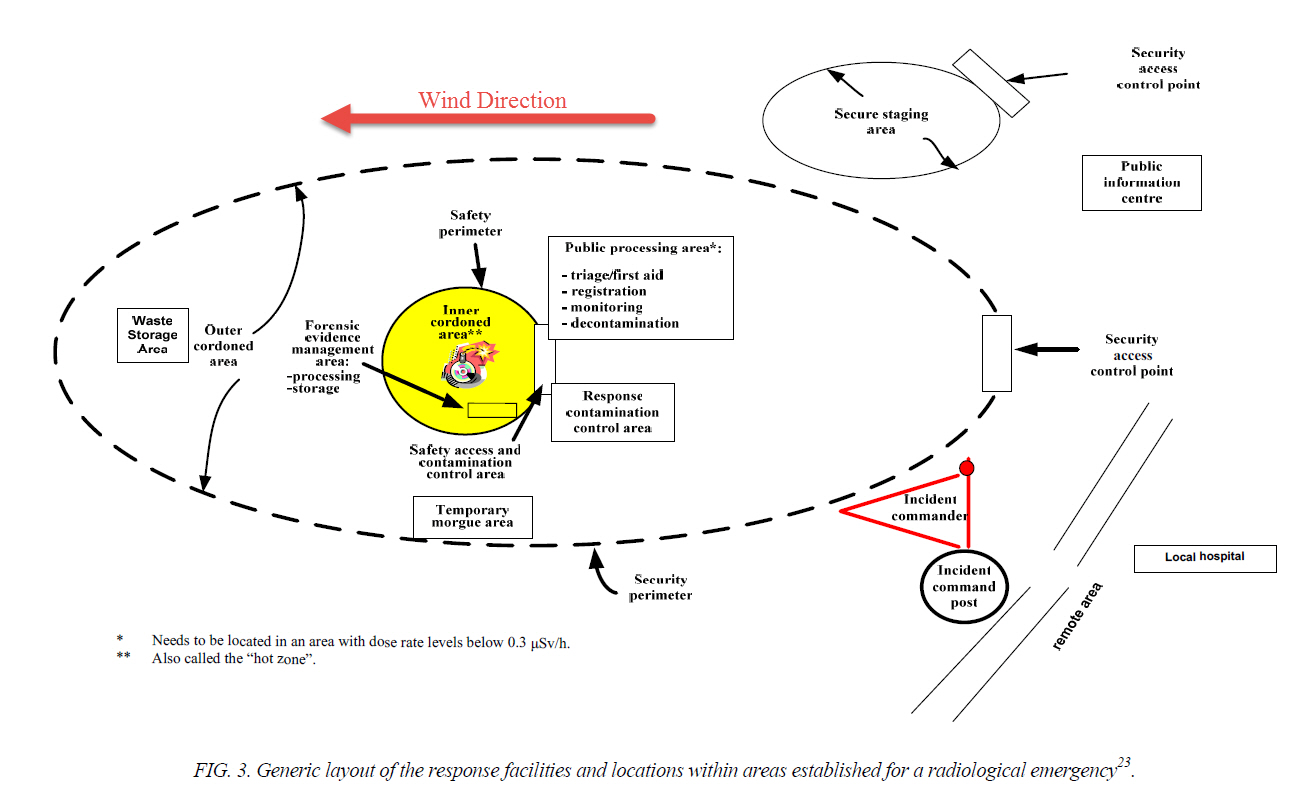
|
Emergency situations |
Inner cordoned area (also called “Hot Zone”) |
Inner cordon
|
10 mrem/h
|
For use by first responder monitor: Ambient dose rate of 100 μSv/h (10 mrem/h) measured at 1 m above ground level or from an object; boundary of inner cordoned area.
Related criteria (for use by radiological assessor only): > 1000 Bq/cm2 gamma/beta deposition > 100 Bq/cm2 alpha deposition |
Establish an ICP and a staging area outside the inner cordoned areas.
For Responders Operating within this area: · Keep account of personnel. · Limit entry to response personnel only. · Follow personnel protection guidelines (Instruction 2). · Continue life saving actions, searching for and rescuing the injured. · Evacuate the public. · Assume that people from the area are contaminated. · Deal with serious conventional hazards (e.g. fire).
For those members of the public who are within the inner cordoned area when first responders arrive: (1) Promptly evacuate as possible. Before evacuation takes place instruct the public to take best available shelter (e.g. go to indoor hall, stay away from windows). (2) Instruct them not to handle, but to isolate and identify to a responder any possible radioactive item. (3) Instruct them not to smoke, eat, drink or place hands near mouth; to wash hands, shower and change clothes when possible to avoid inadvertent ingestion. |
Although IAEA’s use of “inner cordon” to defines their hot line, recent documents have provided the amplifying information: (also called “Hot Zone”).
The overall guidance in this document is consistent with NCRP recommendations, which should be used for US audiences (especially since NCRP 165 is now available for free download).
Pros: Consistent with NCRP for both radiation and contamination that define a Hot Zone. Concise recommended actions and the document also provides useful forms, action guides, and checklists for various responder roles in the appendixes.
Cons: created for international audiences who use SI units and may have different terminology.
|
|
RDD Focus |
|
10 mR/h |
< 10 – 100 mR/hr within a reasonable distance of the epicenter of the blast.
|
If feasible, establish the Incident Command Post at a location upwind with background radiation levels. If this is not feasible, use an area of less than 2 mR/hr and contamination levels less than 1,000 cpm measured 1-2 inches from the ground with a pancake probe.
If feasible, restrict access to essential individuals. Initial decontamination of first responders should occur near the outer boundary of this area. Uninjured personnel within this zone at the time of the RDD explosion can be directed to proceed directly home to shower if resources do not permit contamination surveying at the scene. (For RDDs containing up to ~1000 Ci, this may be the only zone that exists.)
If feasible, Incident Command and other administrative control functions, triage area, and contamination monitoring area should all be located outside the low radiation zone. Preferably these functions will be located upwind of the RDD site in an area of natural background radiation and no contamination. If not practical, seek areas with minimum radiation and contamination levels, preferably with contamination levels less than 1,000 cpm using a pancake GM, measured 1-2 inches from the ground surface, and radiation levels near background for contamination monitoring, and less than a few mR/hr for other activities.
If staff resources allow, use a pancake GM probe to define the 10,000 cpm boundary (1,000 cpm if feasible) outside of the low radiation zone, and restrict nonessential personnel from this area. It is desirable to control access to this area, and to survey personnel leaving this area for contamination before being released for other activities in order to minimize nuisance contamination spread.
Personal dosimetry is also recommended for workers in the low radiation area.
|
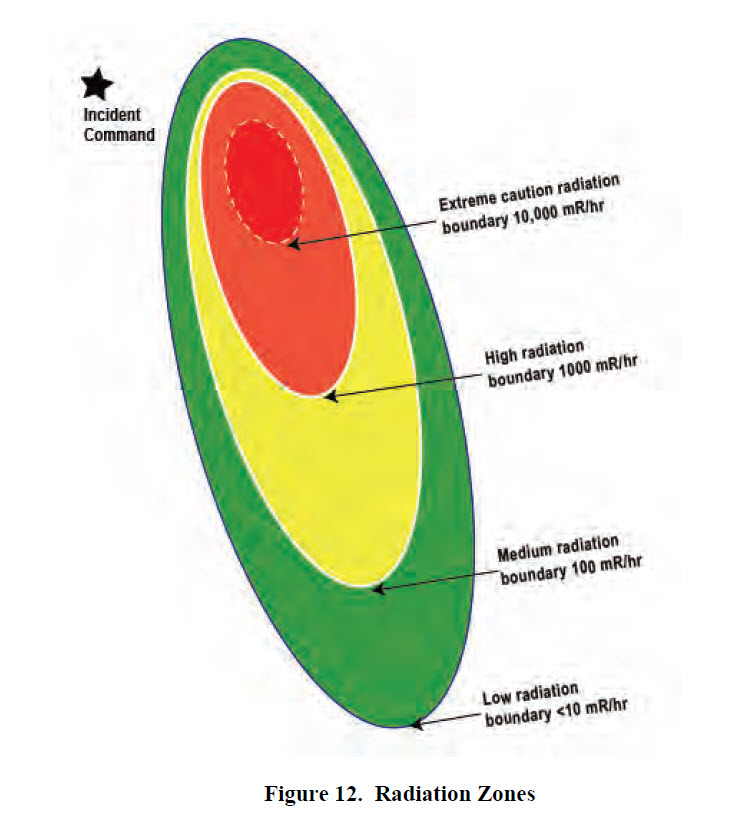
The CRCPD RDD Handbook (and associated foldout response card) does not use the term “Hot Zone,” instead creating 4 different zones.
Pros: It is a practical guide for RDD response, created for a non-technical end-user with some practical rules of thumb and example forms and worksheets.
Cons: It is only for RDDs and the 4 zones have non-descriptive names (low, medium, high, extreme caution radiation zones). The different zones do not have appreciably different activities or protective measures defined. Contamination action levels are provided in CPM which is instrument dependent so actual contamination levels are unclear. |
|
|
RDD Response Guidance; Planning for the First 100 Minutes (DHS, 2017) 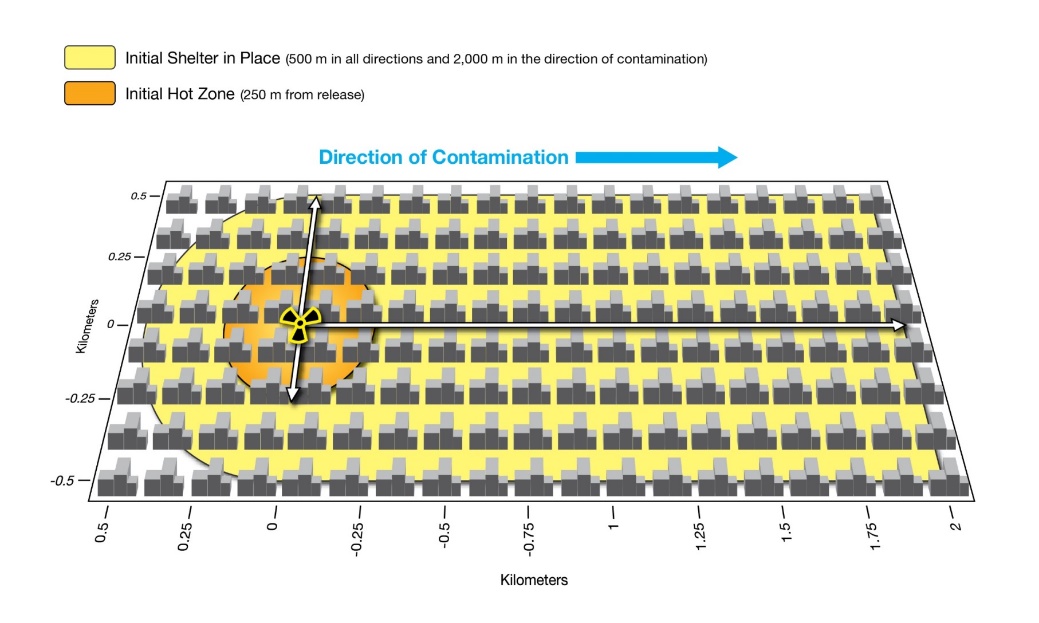
|
Explosive RDD (Dirty Bomb) Incidents |
Hot Zone |
|
10 mR/h
60,000 dpm/cm2 @ 1/2” from surface for beta and gamma surface contamination
6,000 dpm/cm2 @ 01/4” from surface for alpha surface contamination |
Once radiological measurements are available, the Hot Zone perimeter should be re-established at contamination levels that exceed 10 mR/hr (0.1 mGy/hr) or 60,000 disintegrations per minute (dpm) / cm2 at 1.5 cm (~0.5 inch) above the ground for beta and gamma, or 6,000 dpm/cm2 at 0.5 cm (~0.25 inch) above the ground with an alpha probe. |
Hot Zone entry should be limited to first responders conducting lifesaving rescue operations. First responders should continue to operate as needed in the Shelter-in-Place Zone, but all members of the general public should be instructed to remain indoors until notified when and how to leave the immediate area. |
Although the guidance primarily focuses on RDD zone definition by distance, when measurements are available, it uses radiation and contamination values consistent with NCRP 165.
Pros: Provides practical guidance and detailed tactics useful for the first few hours of a response. Includes messaging suggestions and RadResponder integration information.
Cons: Only covers RDD response for the first few hours. |
|
(NCRP, 2005) |
Emergency situations, terrorism focus |
None |
Outer Perimeter |
• 10 mR/h exposure rate (~0.1 mGy/h air-kerma rate);
• 60,000 dpm/cm2 (1,000 Bq/cm2) for beta and gamma surface contamination; and
• 6,000 dpm/cm2 (100 Bq/cm2) for alpha surface contamination. |
The outer perimeter being established as any area that exceeds 10 mR/hr exposure rate or 60,000 dpm/cm2 β/γ and 6,000 dpm/cm2 α contamination levels. |
Within the outer perimeter, the appropriate actions are to evacuate members of the public, isolate the area, and ensure that all emergency workers inside the area minimize their time spent in the area and follow appropriate personal protection guidelines (Section 4.1).
The emergency responders that cross the outer perimeter at the scene of what is determined to be a nuclear or radiological incident should be equipped with alarming personal radiation dosimeters that provide unambiguous alarms, based on predefined levels, to facilitate decision making. It is recommended that the dosimeter provide alarms when the exposure rate reaches 10 R/h (~0.1 Gy/h air-kerma rate), corresponding to the recommended value for the inner perimeter (Section 5.3.2).
|
This commentary adopted the IAEA values for inner cordoned area. It expands the NCRP 138 10 mR/h action level to include contamination information as well
Pros: Consistent with international guidance. Generally superseded by NCRP 165, but shorter and can be read / absorbed more quickly.
Cons: It does not use the term Hot Zone, instead calling it the “outer perimeter.” Must be purchased from NCRP. |
|
NCRP Report No. 138: Management of Terrorist Events Involving Radioactive Material (NCRP, 2001) |
Emergency situations, terrorism focus |
None, however this is the recommended “initial alarm level” |
|
10 mrem/h |
The NCRP recommends that an ambient dose rate of approximately 10 mrem/h (0.1 mSv/h) is a suitable initial alarm level. |
Emergency response personnel assigned to respond to a scene with this equipment should receive training that would include the operational characteristics of the equipment, the operational quantities being measured, and the risks associated with exposures that correspond to the preset levels of the alarms. The NCRP recommends that an ambient dose rate of approximately 0.1 mSv/h is a suitable initial alarm level. This is a value significantly higher than natural background so that false positive indications are avoided, but not so high that an emergency responder is likely to receive an exposure that would approach the annual limit for a member of the general public if exposed in areas below this value. It is also an ambient dose rate at which it would be appropriate to establish an initial control point to restrict access for radiological control purposes to any unnecessary persons. |
|
|
(DHS, 2016) |
Emergency situations, IND focus |
Hot Zone |
|
10 mR/h
|
from 0.093 millisievert to 0.093 sievert/hour (0.01 to 10 roentgen/hour) |
The Hot Zone is the area covered by fallout that creates radiation exposure rates from .093 millisievert to 0.093 sievert/hour (0.01 to 10 roentgen/hour). These levels do not present an acute threat; however, the Hot Zone may warrant protective actions (e.g., sheltering and/or evacuation, food restrictions, and water advisories). Fallout deposition at great distances (e.g., 100 miles) is dictated by the parameters of winds at altitudes of the fallout cloud. The .093 millisievert/hour (0.01 roentgen/hour) line can reach a maximum extent of several hundred miles within hours of the incident and then shrink in size due to decay. Using personal protective equipment and properly monitoring radiation levels are essential for entering the Hot Zone. Emergency operations can be safely performed in the Hot Zone as long as responders take appropriate planning, dose monitoring measures, and protective measures (e.g., using personal protective equipment). Responders entering and operating in the Hot Zone should maintain increased awareness. Staging, triage, and reception centers should be established outside of this area whenever possible. |
The Hot Zone is defined in the appendix for an IND, so technically only applies to an IND response. Although the radiological units chosen are a little odd, they essentially adopt the Federal Planning Guidance for Response to a Nuclear detonation, but they go a little further and actually call it the “Hot Zone.”
Pros: As an annex to the National Response Framework, this document has more gravitas in representing an official federal recommendation than the other documents. The document also has a lot of practical information on the federal response structure and process.
Cons: Uses SI units (with non-standard conversion assumptions).
|
|
Radioactive Materials Transportation And Incident Response (the Q&A booklet) (FEMA 358, 2010) |
Transportation incident |
Hot Zone: Controlled (Contaminated) Area |
Outer boundary |
2 mR/h |
Ideally, radiation exposure should not exceed 2 mR/h at outer boundary of Hot Zone.
|
Only essential personnel and equipment admitted for firefighting, recovery of shipping papers, medical assistance, rescue, extrication, and patient transfer to control line. Ideally, radiation exposure should not exceed 2 mR/h at outer boundary of Hot Zone. Protective clothing and radiological monitoring equipment are recommended for entry. All contaminated items should remain here. |
Added to the matrix because we needed some reference for a 2mR/h definition of a Hot Zone. We were unable to find a peer reviewed federal, national or international standard, guidance, or recommendation. This reference was intended to apply only to transportation accidents.
Pros: Provides ROSS a reference when community pressure or pre-existing SOPs drive the Hot Zone definition to 2mR/h.
Cons: 2 mR/h is a commonly used Hot Zone definition by communities that mis-applied regulatory values to emergency response. This definition can create an unnecessarily large Hot Zone for a large, widespread contamination incident. |
|
NCRP Report No. 161: Management of Persons Contaminated with Radionuclides: Handbook (Table 3.1) |
Regulatory guidance |
|
Control Boundary |
2 mR/h |
Regulatory limit for radiation dose rate in an uncontrolled area |
• Evacuate public if practicable • Establish control boundary |
Table 3.1 is a compilation of regulatory and emergency response guidance. Although the 2mR/h is clearly identified as regulatory value, the actions they provide appear to have an emergency response context.
Pros: Provides ROSS a reference when community pressure or pre-existing SOPs drive the Hot Zone definition to 2mR/h.
Cons: 2 mR/h is a commonly used Hot Zone definition by communities that mis-applied regulatory values to emergency response. This definition can create an unnecessarily large Hot Zone for a large, widespread contamination incident. |
|
NCRP Report No. 161: Management of Persons Contaminated with Radionuclides: Handbook (Table 3.1) (NCRP, 2008) |
Regulatory guidance |
|
|
5 mR/h |
Regulations require posting as radiation area |
Entry requires wearing dosimetry |
Table 3.1 is a compilation of regulatory and emergency response guidance. Although the 5mR/h is clearly identified as regulatory value for requiring dosimetry.
Pros: Provides ROSS a reference when community pressure or pre-existing SOPs drive the Hot Zone definition to 5mR/h.
Cons: 5 mR/h can create an unnecessarily large Hot Zone for a large, widespread contamination incident. |
|
NCRP Report No. 161: Management of Persons Contaminated with Radionuclides: Handbook (section 18.3) (NCRP, 2008) |
RDD Events |
outer contaminated area |
outer perimeter |
10 mR/h Or beta and gamma surface contamination of 60,000 dpm cm–2 (1,000 Bq cm–2) or alpha surface-contamination level of 6,000 dpm cm–2 (100 Bq cm–2). |
Establishment of an outer perimeter is recommended if any of the following are exceeded: • exposure rate of ~0.1 mGy h–1 (10 mR h–1) air-kerma rate, • beta and gamma surface contamination of 1,000 Bq cm–2 (60,000 dpm cm–2); or • alpha surface-contamination level of 100 Bq cm–2 (6,000 dpm cm–2). |
The outer contaminated area has the second highest levels of contamination, resulting from radionuclides being transported by an explosion, by air (wind), or by people walking through the inner area. If radionuclide contamination is totally confined to the immediate area of release, then an outer contaminated area would not be needed. Everyone in the outer contaminated area is likely to be contaminated, and should be required to exit only through a radiation control point, surveyed and, if necessary, decontaminated prior to egress, if not seriously injured. Everyone except for the most seriously injured must be surveyed and decontaminated if necessary prior to exit. In the area between the inner and outer perimeters, it may be difficult to measure directly for contamination levels because of high count rates often associated with even relatively-low levels of radiation dose. In many situations the outer contaminated area will serve as a corridor to the inner contaminated area, the site of the radionuclide release. The radiation control point at the inner perimeter functions to help control access to and from the inner contaminated area. This helps track persons entering and leaving the area, helps ensure that persons entering the area are taking appropriate precautions (including wearing proper PPE), and provides a place to conduct surveys and identify needs for decontamination of persons and equipment leaving the inner contaminated area. Discipline specific guidance can be found in section 18.3.2 |
This section of the Report #161 adopted the recommendations of Commentary #19.
Pros: Consistent with international guidance and NCRP 165.
Cons: It does not use the term Hot Zone, instead calling it the “outer perimeter.” Must be purchased from NCRP. The “decontamination prior to exit” goes against later recommendations not to hold people within |
|
Federal Planning Guidance for Response to a Nuclear Detonation (EOP, 2010)
|
Nuclear Detonation |
|
0.01 R/h boundary |
10 mR/h |
A number of authoritative guidance documents have been produced that cite a zone bounded by a radiation dose rate of 0.01 R/h (10 mR/h) and characterize the area as the ‘hot zone.’ The area bounded by 0.01 R/h may be depicted as an area where radioactivity is found, and the radiation hazard is lower closest to the 0.01 R/h boundary while and the radiation hazard increases approaching the 10 R/h boundary. |
Responder: “Provided responders take appropriate planning and dose monitoring measures, emergency operations can be safely performed within the area bounded by 0.01 R/h. The area bounded by 0.01 R/h should raise awareness of all responders operating in the zone and result in establishing staging, triage, and reception centers outside of this area whenever possible.”
Public: “Those within the area bounded by the 0.01 R/h line should shelter until it is safe to evacuate. For some people in the LD, MD, and DF zones that are not adequately sheltered, are critically injured, or threatened by building collapse or fire, early evacuation may be required for their survival.” |
Pros: For a nuclear detonation, this is the seminal planning guidance. It offers detailed guidance for all issues related to response to a nuclear detonation. It is available for free download and has a companion document on “Communicating in the Aftermath.”
Cons: Although some elements may pertain to other elements of a general radiation emergency, but ws intended for many of the unique aspects and characteristics of a nuclear detonation.
|