There is an unfortunate tendency to treat all CBRN events as having a common approach and controls. This document provides references and discusses applicable Personal Protective Equipment (PPE) requirements for various radiological incidents. State/local procedures established by decisionmakers have precedence and this guidance is meant as a tool to support state/local procedures and decision making. For incident specific Recommendations, contact the Advisory Team for Environment, Food and Health (A-Team) via FDA EOC: 866-300-4374.
Gamma Radiation PPE
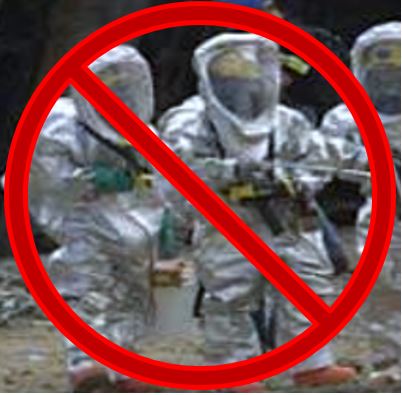
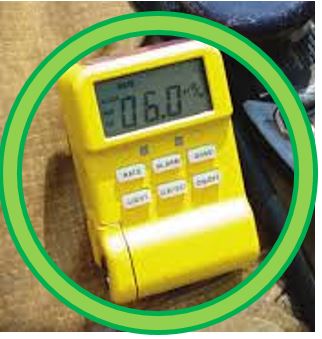
It is important to understand that personal protective equipment used by responders does not protect them from penetrating, gamma radiation. Most of the radiological and nuclear emergencies discussed in this document involve penetrating, gamma radiation and firefighter “turnouts” or “bunker gear;” and Level A, B, or C HAZMAT suits provide no protection from this hazard. The best equipment to protect the responder from gamma overexposure is a monitoring device tracks dose rates and total accumulated dose and that loudly alarms when safety levels are exceeded. The best tactic to protect against gamma exposure is limiting time spent in the radiation field, for this reason heavy and/or bulky PPE (such as Level A and B) are contraindicated as it will slow the responder which will increase their gamma dose.
Respirable Hazards
The uptake of radioactive material into the body represents a concern because the material can remain in the body for long periods which can result in a long term chronic exposure. However, this also means that short lived radionuclides (like fallout or radiopharmaceuticals) are less of an uptake hazard. Because of their short range, Alpha emitting radionuclides are only and internal hazard and their exposure can be entirely controlled by limiting the potential for uptake into the body. Respiratory protection needs will be driven by the airborne concentration, the particle size, chemical nature, and the type and half-life of the radiation. In general, for emergency response, an air purifying respirator is sufficient. SCBAs and/or PAPRs can be used if they do not delay the response or slow the responder in the field.
Contamination Control Clothing
Unlike certain chemical or biological contamination, radiological “skin or wound contamination is never immediately life threatening to affected people.” The main purpose of protective clothing is to simply facilitate decontamination at the end of the response by avoiding a wash-down and the loss of work clothes. Special protective clothing is not required for radiological contamination as responders can be decontaminated regardless of what they wear to the response.
Balancing Risks and Benefits of PPE
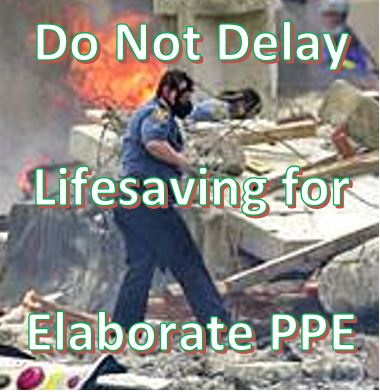
There are risks to wearing PPE as it can decrease a responder’s effectiveness, increase their gamma exposure, and lead to other complications such as heat stress. When properly applied, the benefit is that PPE can facilitate decontamination, minimize radioactive material uptake into the body, and protect against non-radiological hazards (such as fire, sharps, or chemical spills) that may also be at the scene. A key risk vs. benefit decision is in the early phases of an emergency when a delay in response may result in injury or the loss of life. When time sensitive, mission critical activities such as lifesaving are being conducted, the response should not be delayed for contamination control clothing or SCBA or PAPR respiratory protection when the primary hazard is radiological contamination. In the later phases of a response, PPE requirements can be increased to minimize the impact on Hot Line decontamination operations and further reduce the potential for uptake.
Non-radiological hazards that are present (or likely to be present) at the scene should also be taken into consideration when selecting PPE.
Traditional HAZMAT transportation accident response planning is built around the concept of a small, well contained event where every effort is made to avoid contamination leaving the immediate scene. It is important to recognize that for a large-scale event (like Fukushima, a dirty bomb, or nuclear detonation), the “hot line” activities are often for transition from a contaminated area to a slightly less contaminated area so elaborate decontamination methods to remove all contamination are not required. Contamination control efforts should be stepped up when alpha emitters are involved to reduce cross contamination that could lead to accidental uptake through ingestion or inhalation. Thick clothing (like firefighter turnouts) can provide some protection from beta radiation, however this exposure is a secondary concern to gamma exposure and alpha uptake (if alpha emitters are present).
Table 1: Summary of PPE Recommendations for Various Situations
|
Situation |
Recommended PPE |
Minimum Required (use for lifesaving) |
|
Orphan Source (sealed source, no contamination) |
· Alarming Personal Emergency Radiation Detector |
No requirement |
|
Transportation accident |
· SCBA and structural firefighters’ protective clothing · Alarming Personal Emergency Radiation Detector |
No requirement |
|
First 15 minutes after a RDD |
· Alarming Personal Emergency Radiation Detector · SCBA · Gloves · Regular Duty Uniform |
· APRs (any type) · Eye protection · Gloves & Duty Uniform |
|
RDD Response (> 15 minutes) |
· Alarming Personal Emergency Radiation Detector · Half-face APR with P100 or HEPA filter · Goggles · Gloves · Regular Duty Uniform |
· N95 Respirator · Protective Eyewear · Gloves & Duty Uniform |
|
Nuclear Detonation (Fallout Hot Zone or Dangerous Radiation Zone) |
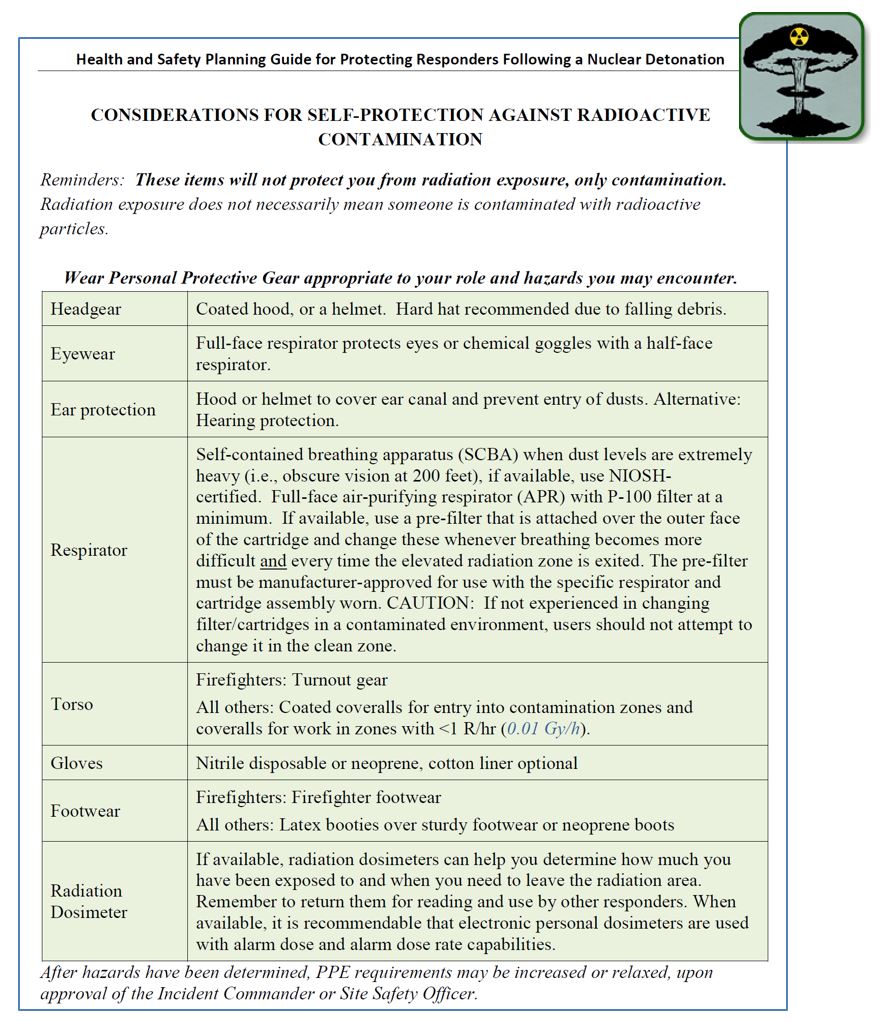
· Alarming Personal Emergency Radiation Detector · Helmet or Hard hat with Hearing protection · Eye Protection · SCBA when dust levels are extremely heavy (i.e., obscure vision at 200 feet). Full-face air-purifying respirator (APR) with P-100 filter at a minimum. · Turnout gear or coated coveralls for entry into contamination zones and coveralls for work in zones with <1 R/hr. · Gloves Nitrile disposable over neoprene, cotton liner optional · Firefighter footwear or Latex booties over sturdy footwear or neoprene boots |
Hot Zone: · PPE appropriate for the non-radiological hazards (including no PPE if no other hazards) Dangerous Radiation Zone: · Radiation Detector · PPE appropriate for the non-radiological hazards (including no PPE if no other hazards) |
In 2016 and 2017 Federal PPE guidance was released for response to an RDD and nuclear detonation. These documents provide the most recent thinking on PPE needs for response to radiological or nuclear terrorism. Guidance for the 2017 Radiological Dispersal Device (RDD) Response Guidance; Planning for the First 100 minutes and the 2016 Health and Safety Planning Guide; For Planners, Safety Officers, and Supervisors For Protecting Responders Following a Nuclear Detonation can be found below.
|
Radiological
Dispersal Device (RDD) Response Guidance Minimum Recommended PPE for Responders in Initial RDD Response |
|||
|
Equipment |
Hazard |
Protection |
Timeframe in the Response |
|
APRs (any type) |
Airborne Radioactivity |
If SCBA is not available, protects responders from inhalation of airborne particles |
For the first 15 minutes of the response (if SCBA is not available) |
|
Positive Pressured SCBA |
Airborne Radioactivity |
Protects responders from inhalation of airborne particles |
For the first 15 minutes of the response |
|
Full-face APR with P100 or HEPA filter |
Airborne Radioactivity |
Protects responders from inhalation of airborne particles |
In the first 15 minutes, if wearing SCBA degrades ability to conduct operations (such as when driving) |
|
Half-face APR with P100 or HEPA filter |
Low-level Airborne Radioactivity |
Protects responders from inhalation of airborne particles |
After the first 15 minutes |
|
N95 Respirator |
Low-level Airborne Radioactivity |
Protects responders from inhalation of airborne particles |
After the first 15 minutes |
|
Eye Protection |
Removable Contamination |
Protects responders from eye contamination |
Throughout response |
|
Gloves |
Removable Contamination |
Protects responders from skin contamination |
Throughout response |
|
Regular Duty Uniform |
Removable Contamination |
Protects responders from skin contamination |
Throughout response |
|
Reference |
Applies To: |
PPE |
Text from Guidance |
Discussion |
|
Nuclear Detonation |
See above |
The primary consideration in selecting appropriate PPE is whether it will be worn in the DF zone and/or the elevated radiation area, or outside of the fallout zones. The DF zone is immediately dangerous to life and health. Level B PPE is required for first responders or other personnel working inside the DF zone, where contact with fallout and other HAZMAT (including chemical gas or vapors) is likely. The elevated radiation area poses the risk of radiation exposure and contaminated environment, victims and equipment. The PPE required depends on surface and airborne contamination levels. Responders working in the fallout zones will likely start in Level B, but may be directed to switch to Level A or C by the IC when radiation and contamination levels are better defined. The area outside of the elevated radiation area, by definition, should be completely uncontaminated. Nevertheless, low levels of contamination will arise due to movement of responders, equipment between zones, and especially from contaminated victims who will self-evacuate from the fallout zones. Responders outside of the fallout zones, but coming in contact with contaminated victims, should use Level C or D PPE depending on their proximity to the fallout zone perimeter. |
The PPE requirements for this document appear to be based on the blast damage zones where significant other hazards may be present, including fires and non-radiological respirable hazards. For a nuclear detonation, respirable hazards from fallout is minimal in the first few days of the event, even in areas of significant dose rates. This is due to the short half-life and generally non-respirable particle sizes of fallout. Given that the hot zone (>10 mR/h) can go for hundreds of miles, a large portion of this event will be in relatively unscathed communities with no damage and where there is no requirement for non-radiological PPE. In this case, the recommended radiological PPE can simply be a radiation detector. The document also appears to overly simplify into areas of contaminated vs. uncontaminated, whereas in reality there will be very large areas (e.g., the entire eastern seaboard) of detectable contamination that is outside of the Hot Zone and does not represent a hazard. PPE controls should be relaxed under such conditions as the small amounts of fallout contamination to not represent a threat to responders.
|
|
|
Explosive Radiological Dispersal Device (RDD) |
See above |
…recommendations for PPE are aimed specifically at protecting emergency personnel from inhalation of airborne radioactivity and external radioactive contamination. The recommendations do not address protection against other airborne nonradioactive contamination hazards caused by the incident (for example, smoke from a fire). Other hazards at the scene may dictate the need for additional equipment. The recommendations are summarized below.
|
This guidance provides a scalable approach to the response to an explosive RDD. The analysis of the science has helped identify that most of the respirable hazard will pass after 15 minutes, so 2 different recommendations are provided (depending on the arrival time). For contamination control, they recommend the regular duty uniform as a minimum. Note that this is for the first 100 minutes, after lifesaving is complete, contamination coveralls should be considered. |
|
|
Explosive RDD |
· P100 filter or a HEPA Respirator · Eye protection · Duty uniform |
To protect the responders from inhaling airborne radioactivity while assuring an optimal immediate response to the incident, using a positive-pressure, self-contained breathing apparatus (SCBA) to the extent practical is recommended for the first to 10-15 min after the detonation. Recognizing that wearing an SCBA may not be possible while driving a vehicle, then drivers should wear a full-face air-purifying respirator with a P-100 filter or a HEPA filter instead. To further minimize the driver’s exposure to airborne particulates inside the cab, the windows of the vehicle should be closed and remain so, and the ventilation system set to recirculation. These recommendations are aimed specifically toward protecting the responders/drivers from inhaling radioactive particulates; they do not address protection against other airborne nonradioactive contaminants. |
Superseded by the 2017 Radiological Dispersal Device (RDD) Response Guidance; Planning for the First 100 minutes.
Provides guidance for non-firefighters. |
|
|
IAEA Manual for First Responders to a Radiological Emergency (IAEA, 2006) |
|
If applicable use available respiratory protection |
Actions for first responders in a radiological emergency: · Follow your standard safety procedures · Be visually identifiable. · Minimize time near a potentially dangerous source. · Do not touch/hold suspected radioactive items. · If applicable use available respiratory protection. · Keep hands away from mouth, do not smoke, eat or drink and wash hands regularly. · Ensure your name/activities performed are recorded. · Get monitored and registered. · Shower and change clothing as soon as possible. |
Does not provide specific PPE recommendations. |
|
NCRP Report No. 161: Management of Persons Contaminated with Radionuclides:Handbook |
|
· Anti-contamination clothing · Respiratory protection |
Entry into a contaminated area should be made deliberately and cautiously. Determine radiation levels prior to entry.... Wear appropriate protective clothing. 33 Bq (2,000 dpm); alpha ; 1,670 Bq (100,000 dpm); beta/gamma: Re-suspended contamination may lead to inhalation or ingestion risk • High control • Wear anti-contamination clothing • Consider respiratory protection 16.7 kBq (1,000,000 dpm); alpha, beta, gamma ; Likely to lead to inhalation of significant amounts of activity • Very-high control procedures required • Wear anti-contamination clothing and respiratory protection |
The recommendations in this document appear to be based on routine, operational activities. Emergency response is working within inherently unknown situations where requirements like “determine radiation levels prior to entry” become nonsensical.
NCRP 161’s Chapter 3 is a “Compendium of Radiation Facts and Guidance” in which internally inconsistent recommendations are provided. Unfortunately, this results in the appearance of endorsement and this report can be essentially quoted to provide support for just about any value. Table 3.2 lists DOE recommendations for (non-emergency) operational activities and may not be appropriate for emergency phase activities. |
|
|
Public: · Improvised respiratory protection
Responders: · Air-purifying respirators · Standard protective clothing (e.g., firefighting/bunker gear) |
General Public Using improvised respiratory protection by breathing through a dry cloth reduces the exposure from inhalation of airborne activity in the passing plume and from resuspension.
First Responders At the scene of an RDD incident, standard protective clothing (e.g., firefighting/bunker gear) and respiratory protection devices are sufficient to protect emergency responders from contamination by radioactive material (NCRP, 2005). The wearing of PPE should be based on the hazards of the mission assigned (e.g., by detection with radiation survey devices or as a consequence of intelligence information). Firefighting hazards require full firefighting PPE. Air-purifying respirators are sufficient to protect emergency responders from resuspension outdoors (Musolino and Harper, 2006). |
|
|
|
|
· respiratory protection · standard protective clothing (i.e., bunker gear) |
At the scene of an incident, standard protective clothing (i.e., bunker gear) and respiratory protection devices are sufficient to protect emergency responders against personal contamination by radioactive materials when conducting life-saving and other critical missions (Section 5.3.5). |
Presumes responders are firefighters. |
|
|
DOT Emergency Response Guidebook (DOT, 2016)
|
Transportation Incidents |
Responders: · SCBA · Standard protective clothing (e.g., firefighting/bunker gear) |
Positive pressure self-contained breathing apparatus (SCBA) and structural firefighters’ protective clothing will provide adequate protection against internal radiation exposure, but not external radiation exposure. Radiation presents minimal risk to transport workers, emergency response personnel and the public during transportation accidents. Packaging durability increases as potential hazard of radioactive content increases. |
The guidance presumes a fire department response, so the wording on the PPE is not so much a requirement as a statement of what the presumed PPE can protect against. |